
 Français
 Español
 Deutsch
 English
Football pitch lighting: E1 to E7 levels, lux, uniformity and mast layout
For a football pitch, successful LED lighting depends just as much on mast layout as on floodlight selection. The study must check the horizontal illuminance level, U1h and U2h uniformity, glare rating (GR), colour rendering index (CRI), mast height, aiming angles and neighbouring-site constraints.
Overview of football lighting and the STADÉLUM approach
Outdoor football pitch lighting must provide comfortable game reading, good ball visibility, sufficient uniformity across the playing area and controlled glare. STADÉLUM approaches these projects through a site analysis: pitch dimensions, available setback, mast height, neighbouring constraints, target sports level, number of floodlights and control strategy.
Which lighting level should be selected for a football pitch?
For a local authority or a club, the right level first depends on the competitions hosted. An E6 installation may be sufficient for departmental use, while a regional project will generally target E5. Higher levels require stricter performance for lux, uniformity, glare and, in some cases, vertical illuminance.
75 lux maintained. A useful level for training pitches and supervised use.
150 lux at commissioning and 120 lux to be maintained, with uniformity control.
250 lux at commissioning and 200 lux to be maintained, for a more demanding level of play.
Stricter requirements: lux, U1h, U2h, GR, CRI and, depending on the level, vertical control.
1. Football pitch dimensions
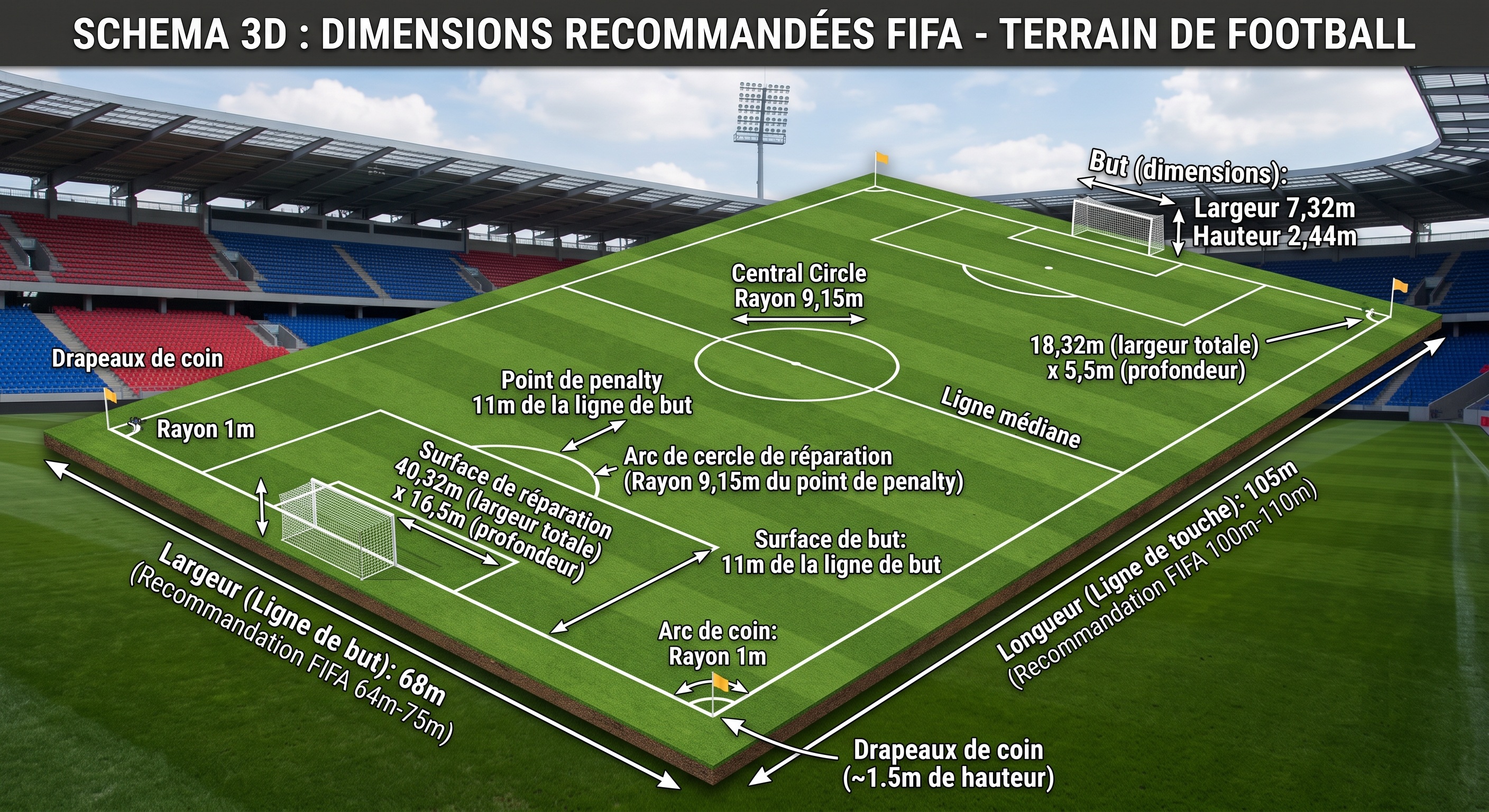
The Federation recommends a reference playing area of 105 × 68 m. This baseline is essential for positioning measurement points, defining safety zones and preparing mast locations around the pitch.
2. Regulations and E1 to E7 illuminance levels
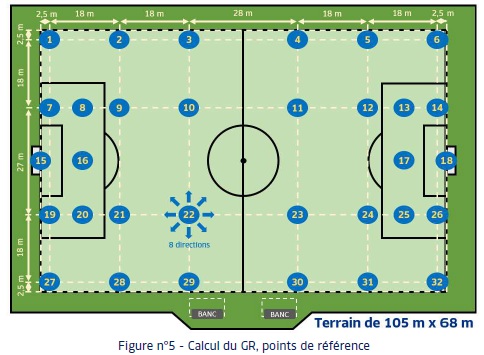
The E1 to E7 levels define the target classification: international competitions, professional football, national, regional, departmental or training use. The target is not limited to average lux: it also includes U1h and U2h uniformity, glare rating (GR) and the colour rendering index.
| Level | Typical use | Avg Eh at commissioning | Maintained avg Eh | Maintained backup Eh | U1h Emin/Ehmax | U2h Emin/Ehavg | GR | CRI / Ra |
|---|---|---|---|---|---|---|---|---|
| E1 | FIFA / UEFA international competitions | 2300 lux | 1840 lux | 1250 lux | ≥ 0.60 | ≥ 0.70 | ≤ 50 | ≥ 70 |
| E2 | Ligue 1 and Ligue 2 | 1250 lux | 1000 lux | 700 lux | ≥ 0.50 | ≥ 0.70 | ≤ 50 | ≥ 70 |
| E3 | National | 750 lux | 600 lux | 400 lux | ≥ 0.40 | ≥ 0.70 | ≤ 50 | ≥ 70 |
| E4 | National 2 and National 3 | 400 lux | 320 lux | — | — | ≥ 0.60 | ≤ 50 | ≥ 60 |
| E5 | Regional | 250 lux | 200 lux | — | — | ≥ 0.60 | ≤ 50 | ≥ 60 |
| E6 | Departmental | 150 lux | 120 lux | — | — | ≥ 0.40 | — | ≥ 60 |
| E7 | Training | — | 75 lux | — | — | ≥ 0.40 | — | ≥ 60 |
Vertical illuminance for E1 to E3 pitches
For televised E1 to E3 pitches, lighting control is not limited to horizontal illuminance. Vertical illuminance must also be checked according to the camera viewing axes, to ensure clear visibility of players and action for broadcast cameras.
| Criterion | E1 | E2 | E3 | ||
|---|---|---|---|---|---|
| Ev1 / Ev2 | Ev3 / Ev4 | Ev1 / Ev2 | Ev3 / Ev4 | Ev1 / Ev2 | |
| Maintained avg Ev | 1400 lux | 1000 lux | 1000 lux | 600 lux | 600 lux |
| Ehavg / Evavg ratio | between 0.5 and 2 | — | |||
| U1v ratio Evmin / Evmax | ≥ 0.40 | ||||
| U2v uniformity Evmin / Evavg | ≥ 0.60 | ||||
| Inspection frequency | Every 6 years and/or whenever required by the competition | ||||
Why is a photometric study essential?
On a football pitch, two installations using the same power can produce very different results. The study verifies the consistency between the target level, existing or proposed masts, optics, floodlight tilt, glare and the light that is actually useful on the playing area.
3. Lighting measurements: how are the levels calculated?
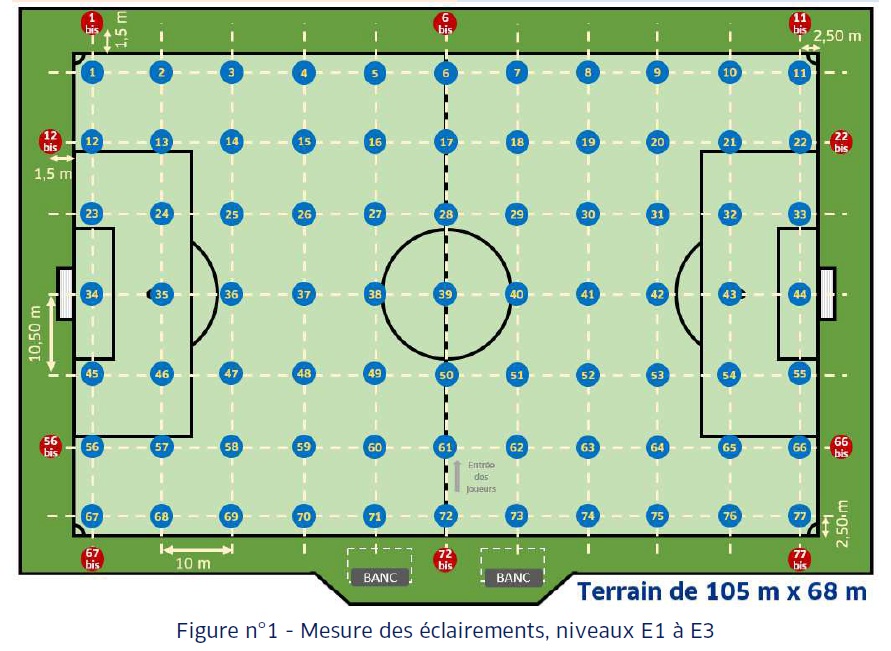
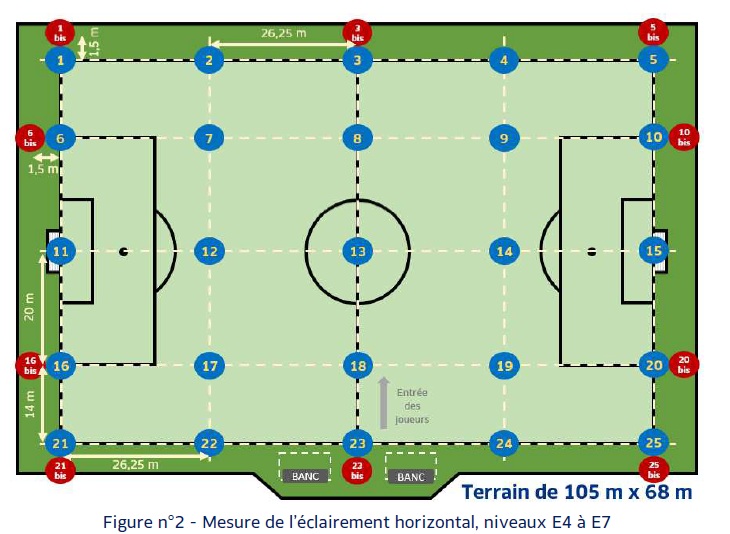
The average horizontal illuminance level, Ehavg, is calculated from the control points defined on the playing area. Additional points around the playing area are used to check that the perimeter zones remain sufficiently lit.
4. Layout examples and positioning rules
Mast layout determines the photometric result, uniformity and visual comfort. Floodlights must not only be powerful: they must be positioned, aimed and tilted to illuminate the playing area while limiting glare and spill light.
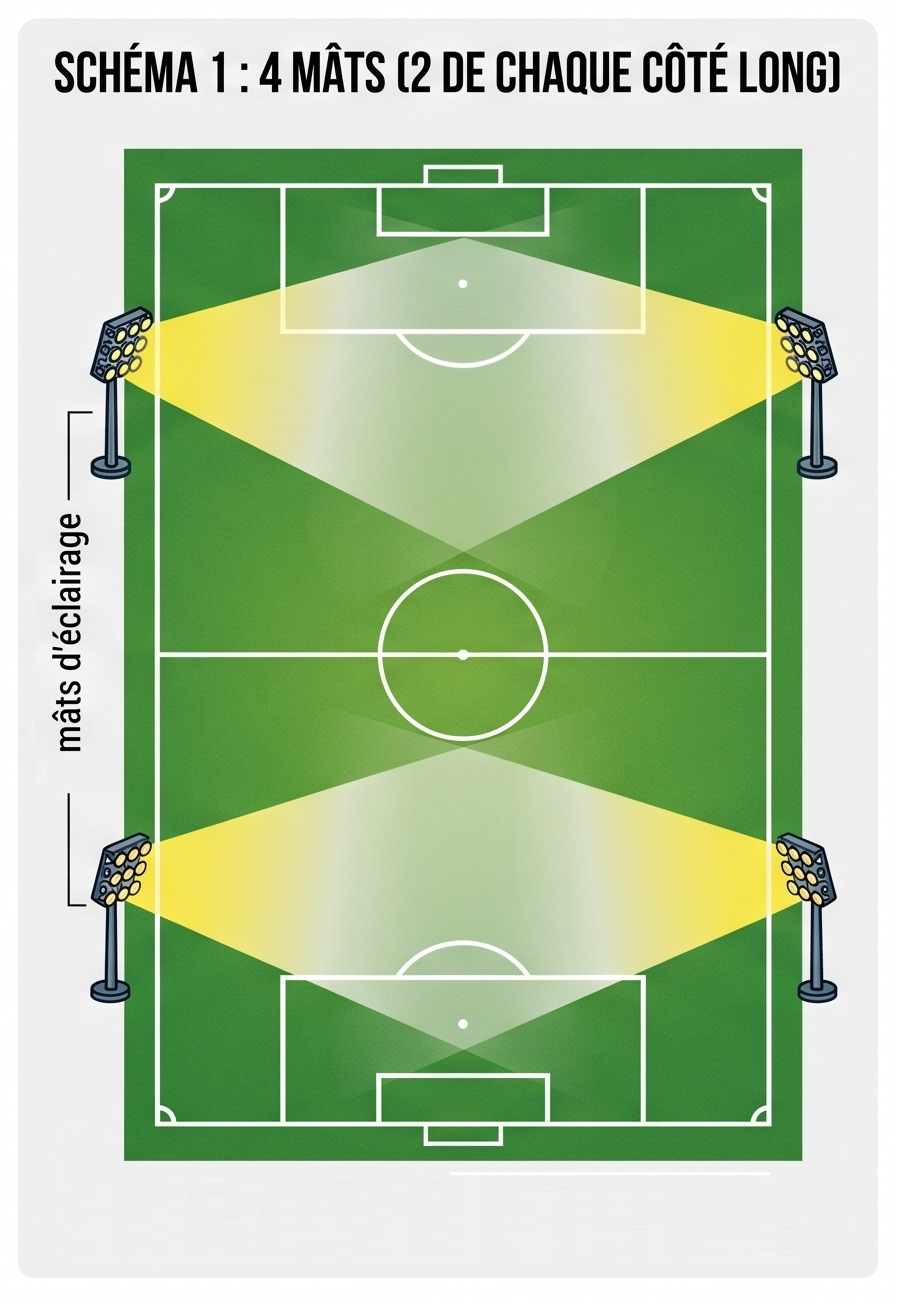
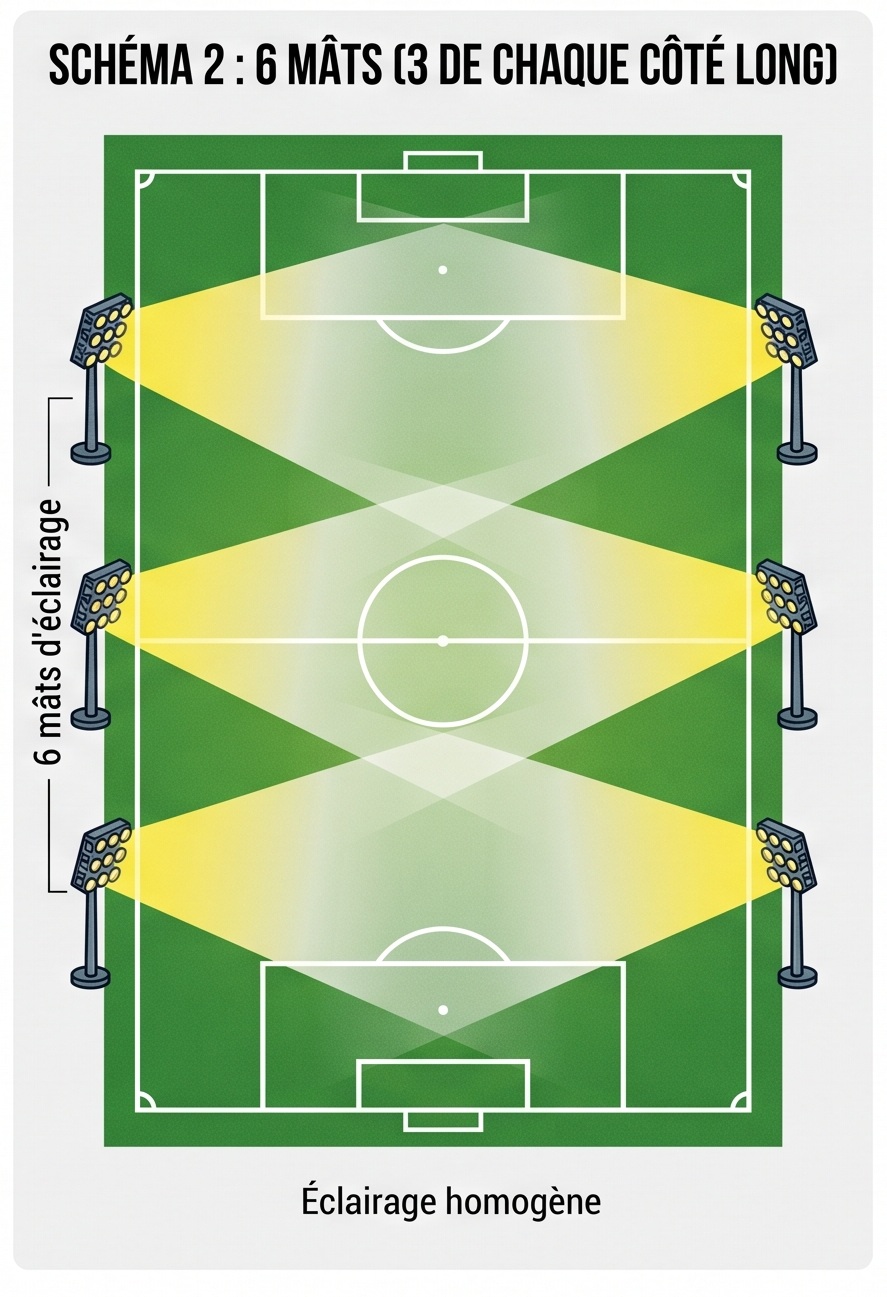
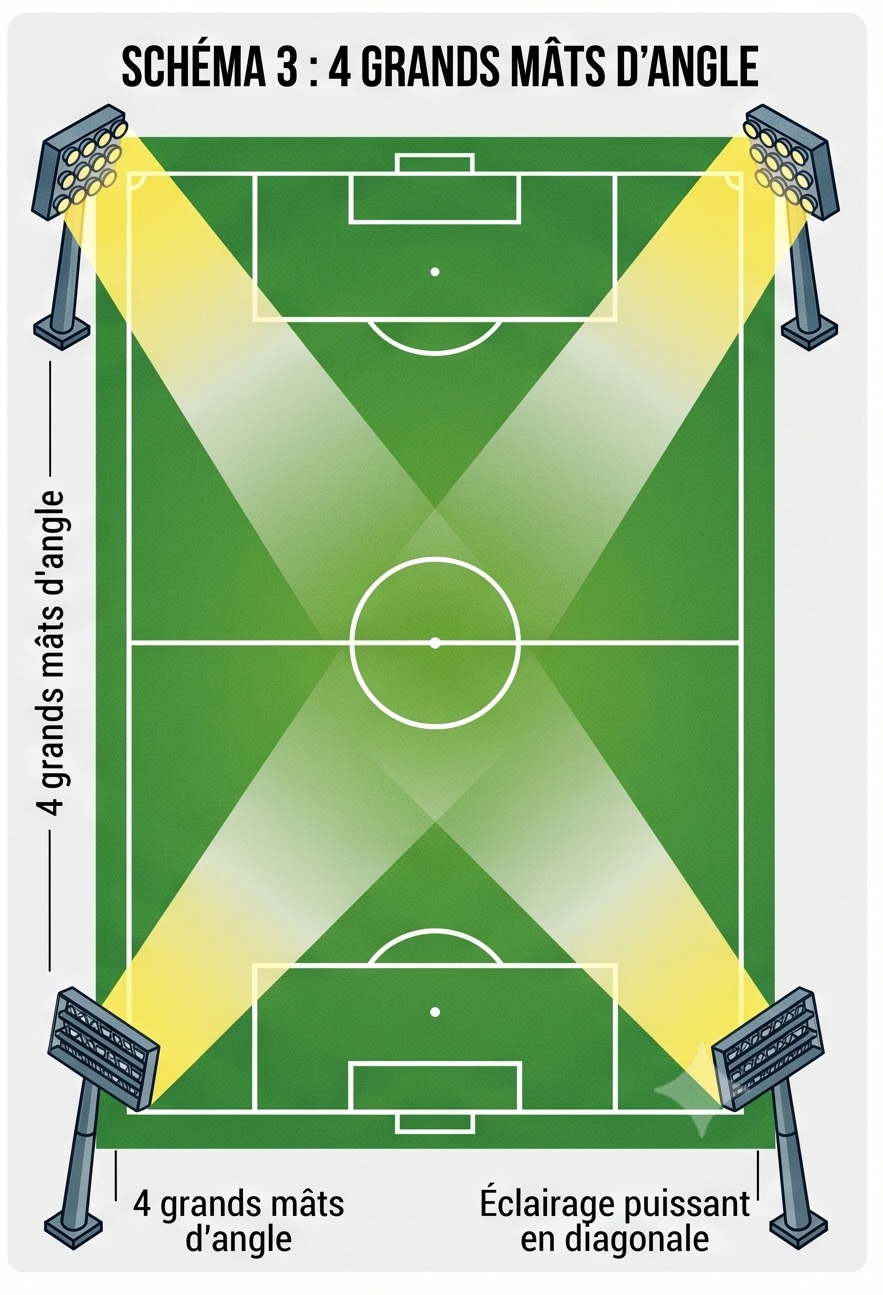
Minimum distances and lighting line
- Lighting line at least 12 m away for E1 levels.
- Lighting line at least 6 m away for E2 and E3 levels.
- Lighting line at least 2.5 m away for E4 to E7 levels.
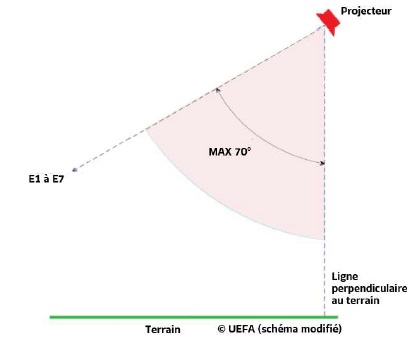
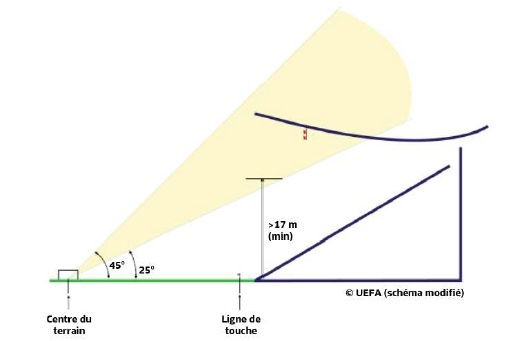
- Maximum optical-axis tilt: ≤ 70° from the vertical.
Height, angles and goal area
- Hmin = (d + w/2) × tan(25°)
- Hmax = (d + w/2) × tan(45°)
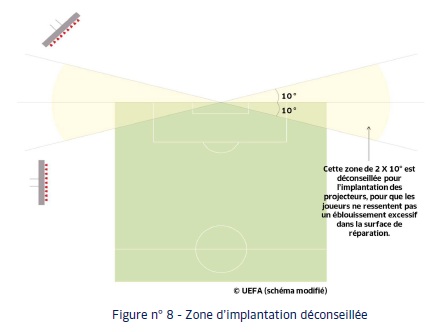
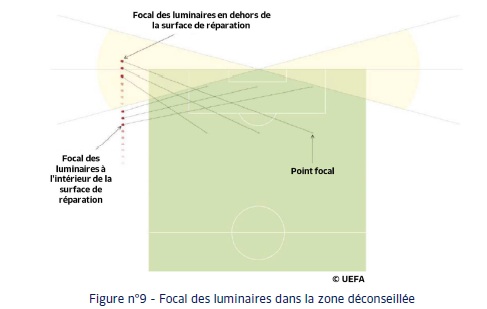
- 10° zone on either side of the goal lines to be avoided, unless a specific focal-point study is carried out.
Technical diagrams of layout rules
These diagrams complement the standard layouts: they help visualise the maximum floodlight tilt, mounting heights, the 10° zone discouraged behind the goals, and the special case where the focal point remains outside the penalty area.
5. STADÉLUM layout examples for E5 and E6 levels
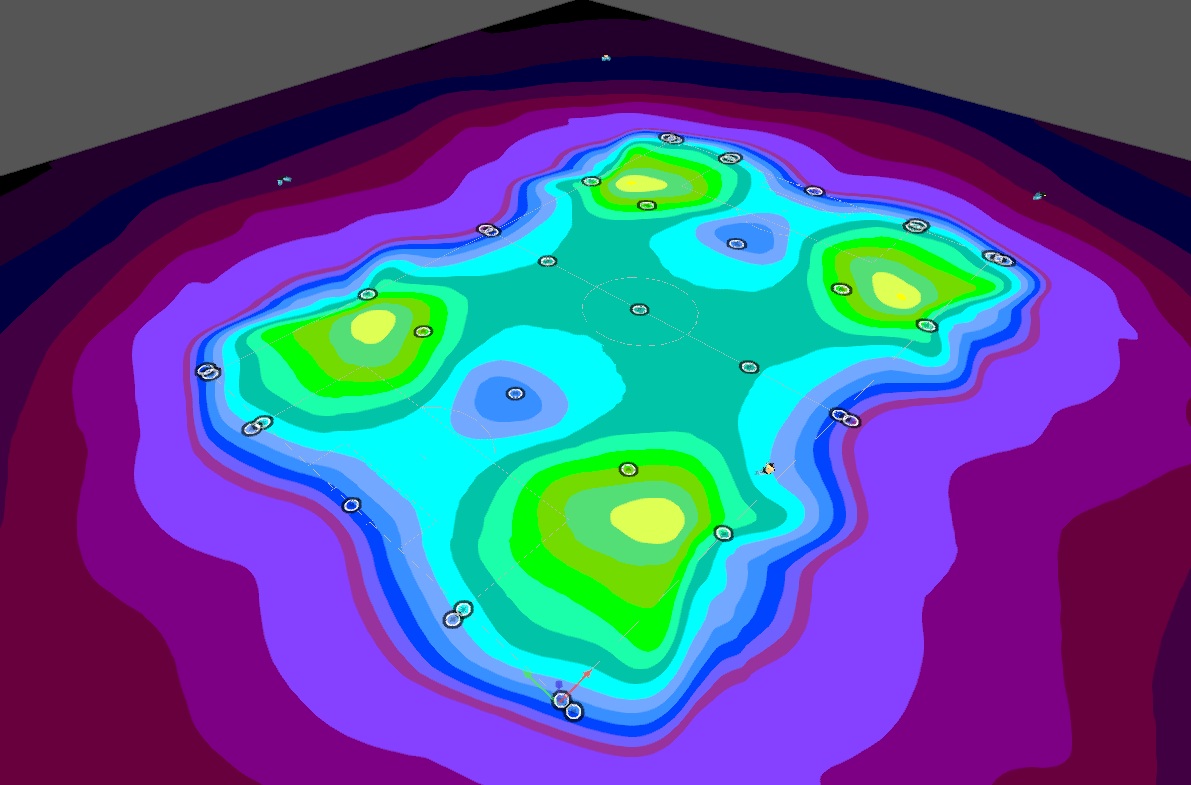
The examples below are presented as study configurations for E5 and E6 levels. The photometric results come from the supplied measurement file: average horizontal illuminance, U1h and U2h uniformity.
E6 example – Departmental
View the 25 E6 calculation points
| Point | Horizontal illuminance |
|---|---|
| 1 | 144 lux |
| 2 | 148 lux |
| 3 | 106 lux |
| 4 | 143 lux |
| 5 | 124 lux |
| 6 | 172 lux |
| 7 | 214 lux |
| 8 | 117 lux |
| 9 | 215 lux |
| 10 | 171 lux |
| 11 | 102 lux |
| 12 | 155 lux |
| 13 | 164 lux |
| 14 | 155 lux |
| 15 | 102 lux |
| 16 | 184 lux |
| 17 | 207 lux |
| 18 | 118 lux |
| 19 | 210 lux |
| 20 | 181 lux |
| 21 | 147 lux |
| 22 | 156 lux |
| 23 | 96.8 lux |
| 24 | 154 lux |
| 25 | 129 lux |
E5 example – Regional
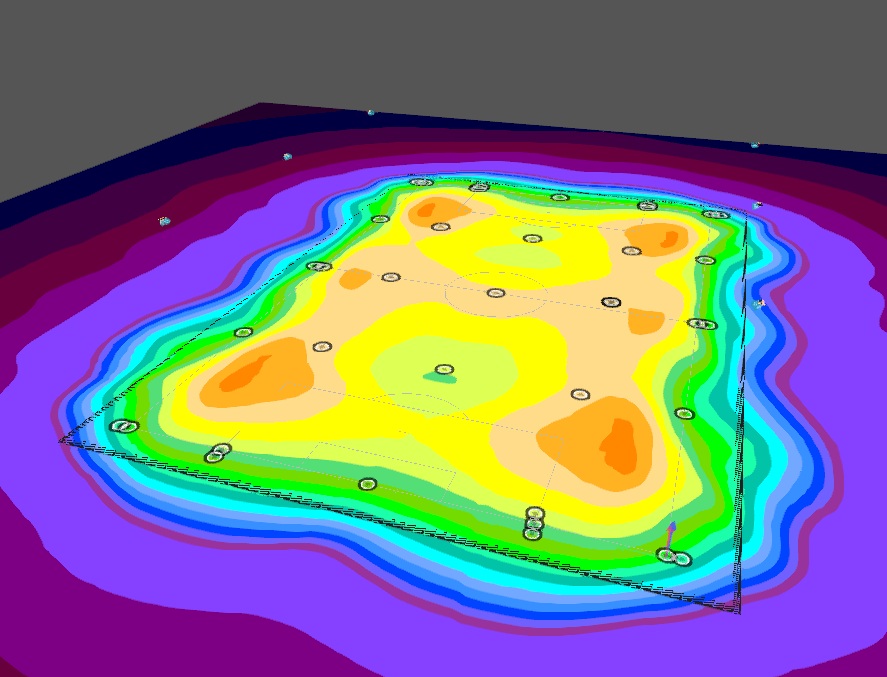
View the 25 E5 calculation points
| Point | Horizontal illuminance |
|---|---|
| 1 | 222 lux |
| 2 | 253 lux |
| 3 | 226 lux |
| 4 | 257 lux |
| 5 | 195 lux |
| 6 | 216 lux |
| 7 | 343 lux |
| 8 | 263 lux |
| 9 | 344 lux |
| 10 | 214 lux |
| 11 | 254 lux |
| 12 | 352 lux |
| 13 | 332 lux |
| 14 | 377 lux |
| 15 | 246 lux |
| 16 | 221 lux |
| 17 | 357 lux |
| 18 | 287 lux |
| 19 | 359 lux |
| 20 | 228 lux |
| 21 | 190 lux |
| 22 | 249 lux |
| 23 | 208 lux |
| 24 | 241 lux |
| 25 | 185 lux |
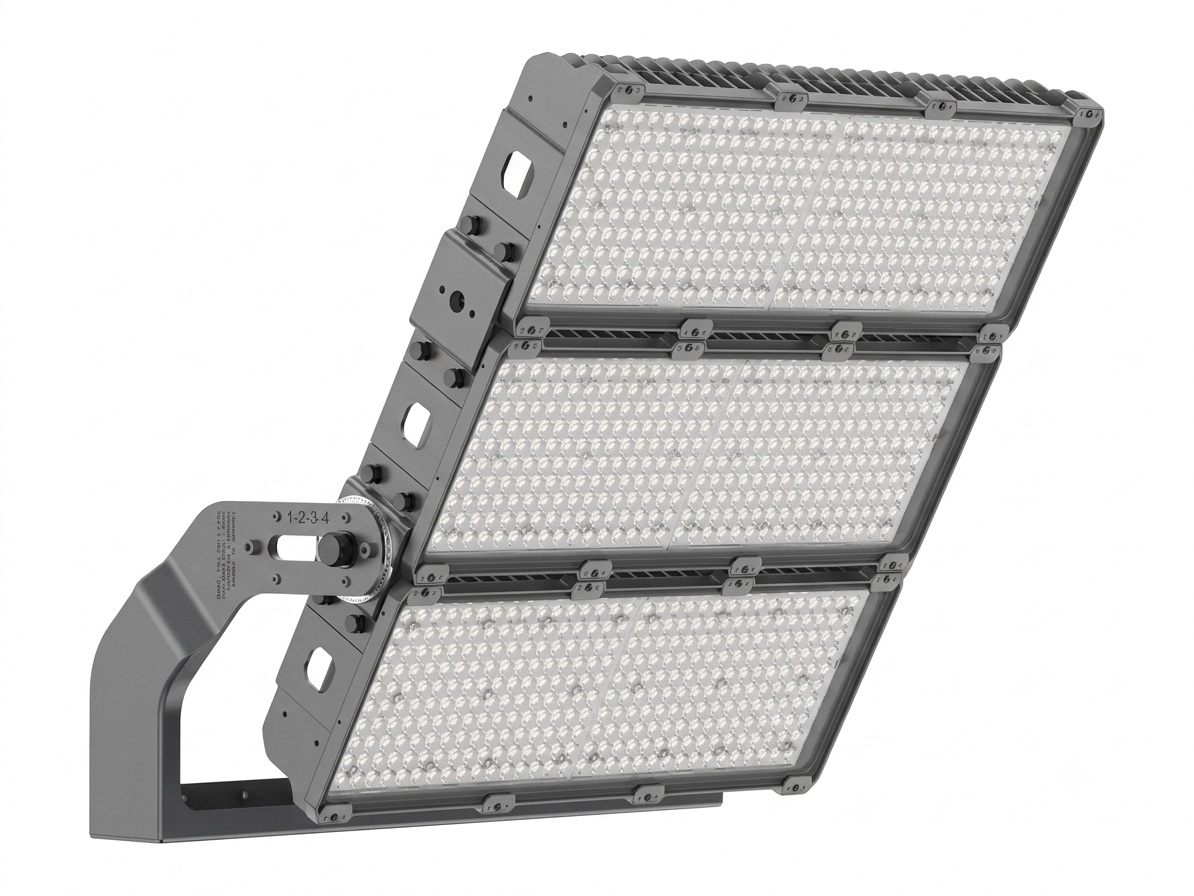
6. ARENA STADIUM floodlight
ARENA STADIUM is designed for outdoor sports pitches, stadiums and large sports facilities. For football, it allows power, optics, visual comfort and glare limitation to be addressed within a photometric-study approach.
7. DALI control, time clock and scenarios
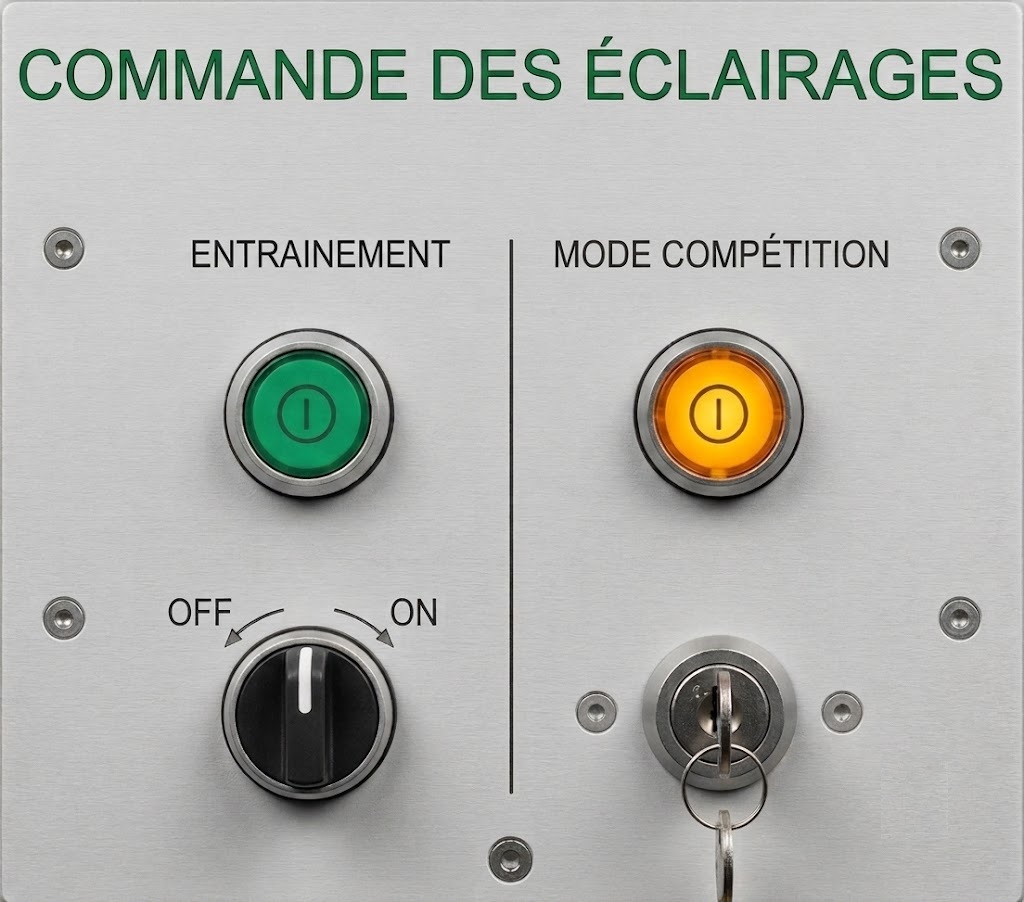
As ARENA STADIUM luminaires are DALI-compatible, a project can include control scenarios adapted to stadium use: training, competition, switch-off or intermediate levels. Control can also be linked to a time clock to schedule switching-on, switching-off or dimming periods according to pitch use.
- Training scenario: reduced output when the maximum level is not required.
- Competition scenario: activation of the level corresponding to the target classification.
- Time-clock control: programming of switching-on, switching-off or dimming according to the club’s time slots.
- Switch-off or dimming: reduced consumption outside playing time.
- To be validated through the electrical study, wiring and site control strategy.
Go further with your football project
Do you have a football pitch lighting project?
STADÉLUM can review the target level, dimensions, mast setback, mounting height, optical selection, glare, measurement points, installed power and control scenarios before pricing the solution.
What the study helps verify
- Target E5, E6 or another classification level.
- Ehavg, U1h, U2h and GR according to the specification.
- 4-mast, 6-mast or corner-mast layout.
- Height, tilt, lighting line and glare zones.
- DALI control, time-clock and energy-saving options.